
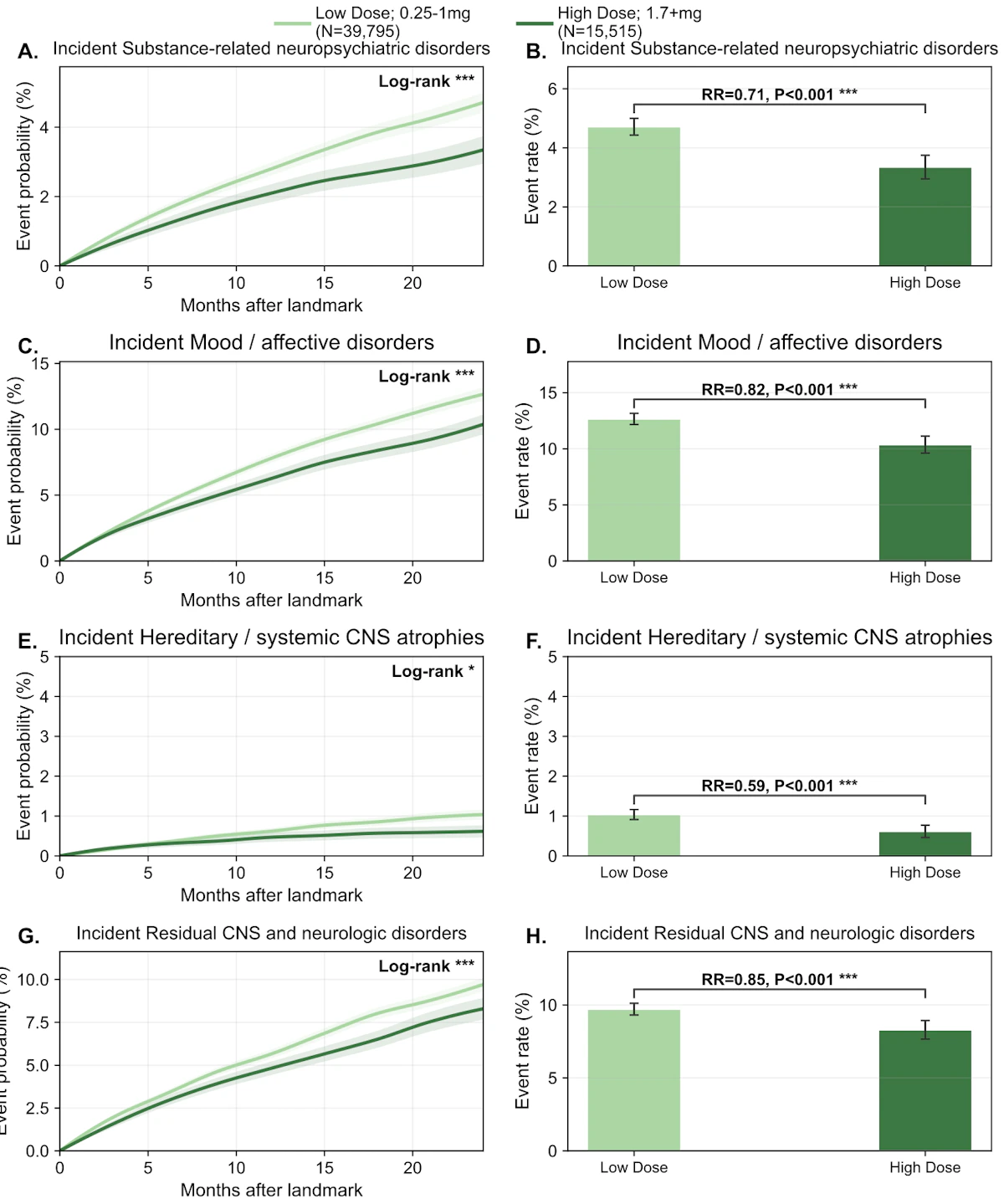
For most diagnosis groups studied, later incidence was more strongly associated with maximum attained dose; cognitive and speech symptoms were exceptions that tracked more with weight loss.
The research question
Are later neuropsychiatric outcomes more closely associated with attained semaglutide dose or with achieved weight loss?
Overview
An observational analysis of 63,215 semaglutide-treated patients with baseline neuropsychiatric conditions compared later outcomes by attained dose and weight change. Higher doses were associated with lower incidence of several diagnosis groups; dementia incidence did not differ significantly.
Study design & methods
The researchers identified 489,785 semaglutide-treated patients in a federated EHR network and assembled 63,215 with baseline neuropsychiatric conditions. Bulk and single-cell transcriptomic datasets were used to map GLP1R expression in brain regions and peripheral nerves as contextual, not causal, evidence.
Associations differed across outcome domains
Semaglutide was associated with lower two-year risk than metformin for several affective, substance-use, vascular and cognitive-neurological outcomes. Compared with metformin, incident mood disorders were documented in 10.5% of semaglutide patients and 13.2% of matched controls during the initial two-year period.
Limitations & interpretation
Published in npj Metabolic Health and Disease. These observational associations do not establish a pharmacologic dose response: attained dose also reflects tolerability, adherence, access, and persistence. Healthy-adherer bias and residual confounding may explain part of the pattern. Transcriptomic findings provide exploratory context, not proof of a brain mechanism.
Publication type and venue follow the original nference listing. Read the original paper for full methods, analyses, and interpretation. View source listing.